Marco Polo
YEAR
2021
LOCATION
Southern Alichur Range, Murghob District, Gorno-Badakhshan
SCI Recordbook -
193 5/8" • Rank 195 • Bronze
outfitter
The Hunting Consortium
Thin Air
Marco Polo Argali was not on my bucket list. That’s the list of aspirations that are within reason and within reach.
I’m from sea level for one thing, not a sheep hunter, and the time, location and expense of getting to them made it something I have never remotely considered. When I won the ibex hunt at auction and learned the Marco Polos are hunted from the same camp, it would have been a crime not to and so my ticket was punched.
The mid-Asian ibex hunt from this same trip is its own entry.
This was the first trip where I genuinely thought something bad could happen. I signed up with Global Rescue for emergency and medical evacuation, bought a Garmin with inReach satellite communications, and spent an absurd amount on Ivermectin pills. This trip was during COVID and they couldn’t be found anywhere. I was already getting a med kit from Mountain Medic that included the required meds for high altitude hunting and they really came through for me.
Tajikistan shares borders with Kyrgyzstan, China and Afghanistan. I flew Washington D.C. to Istanbul, then into Dushanbe. From there it would be an 18-hour drive to hunt camp in the Pamir Mountains.
Spent a day in Istanbul. Got there in the rain. Three hours of sleep, wide awake at 3:30am. Looked out the hotel window to see if the weather had cleared and wow. Looking east over the strait connecting the Black Sea to the Sea of Marmara, with Camlica Camii up on the hill. Five more hours and breakfast at the top of the hotel. Hoped the weather would hold because the view was supposed to be spectacular.
Morning on the European side. The Blue Mosque, built during the Ottoman period around 1600, closed for restoration. We went inside the Grand Mosque, formerly the Church of Hagia Sophia. It was built in 537 as a cathedral and was the largest church in the Roman Empire. It was converted to a mosque after the Ottoman conquest. Circles on the floor mark where Roman kings were crowned when the city was Constantinople. Absolutely rich with history.
Watched a guy pull silk thread from silkworm cocoons, then a master weaver at Punto, a well-regarded shop for oriental carpets, making a custom $10,000 silk rug. Sipped tea while another guy tried to sell me a $60,000 rug. I passed. Walked Gate 1 of the Grand Bazaar, the largest and oldest covered market in the world, 4,000 shops and eating joints, including the place owned by the salt-shaker meme guy. Wrapped the day at the aqueduct and a Turkish coffee at some swanky golf course, then headed to the airport for the next leg.
Four-hour flight into Dushanbe around 3am local. Our group of five hunters, one from Idaho, one from California, two from San Antonio, had gear and guns by 6am and headed to the hotel. After a 7-hour power nap, hit the hotel bar for some local flavors. Waitress in the restaurant is 22 and came from Afghanistan four years ago. Her salary is $150 US a month. Her apartment rent is $150 US a month. Applied to emigrate to Canada two years ago, still waiting. She learned English from the Americans in Afghanistan. Still has family there. “They are not safe.” Heartbreaking.
It was suggested not to wander around Dushanbe solo. Got cabin fever and walked 6 miles anyway. Massive statue of Ismoil Somoni, the 10th-century founder of the Samanid dynasty, standing where a Lenin statue used to before they tore it down in 1991. Palace of Nations, their White House. National Museum, which is huge. The opera house. What they say is the second-tallest flagpole in the world.
Up at 5am the next morning to start the long drive to camp. High anxiety day. We overnighted in Khorog on the way. Occasionally there would be a province crossing, complete with security checking passports. They dressed in what I considered old Russian military wear, hats bearing red stars and carrying AK-47s. At one checkpoint, one of the hunters in my vehicle took pictures and a guard saw him, banging on the window and doors wanting his cell phone. It got pretty hairy. Our driver eventually calmed him down with a payoff.
Eight hours of the drive ran the Afghanistan border. The river is the line. Tajik flags on our side, white Taliban flags on the other. Our guide said they sometimes come over and there’s never any trouble. I asked what if we go over there. “They shoot you.”
Guy in our vehicle needed a rest stop. The driver waves his hands, points at the opposite bank, says “no, no stop. Taliban, Taliban!” Poor guy had to wait another five miles.
The entire border stretch was a single-lane rocky dirt road with no guardrails and a straight drop to the river. The driver thought he was in a rally car and had no issue riding the edge to dodge potholes. We were at 7,200 feet. Next morning the last six hours climbed toward camp. Hunt area was south of the village of Murghab, adjacent to the Wakhan Corridor of Afghanistan. Base camp sat at 13,600 feet. The sheep would be found between 13,500 and 15,000.
We saw well over 1,200 sheep that first day. It was wild. Watched rams fighting, full on standing on two legs to get momentum then BAM. Younger sheep would surround the older ones when they sensed things getting dicey. Really interesting to see.
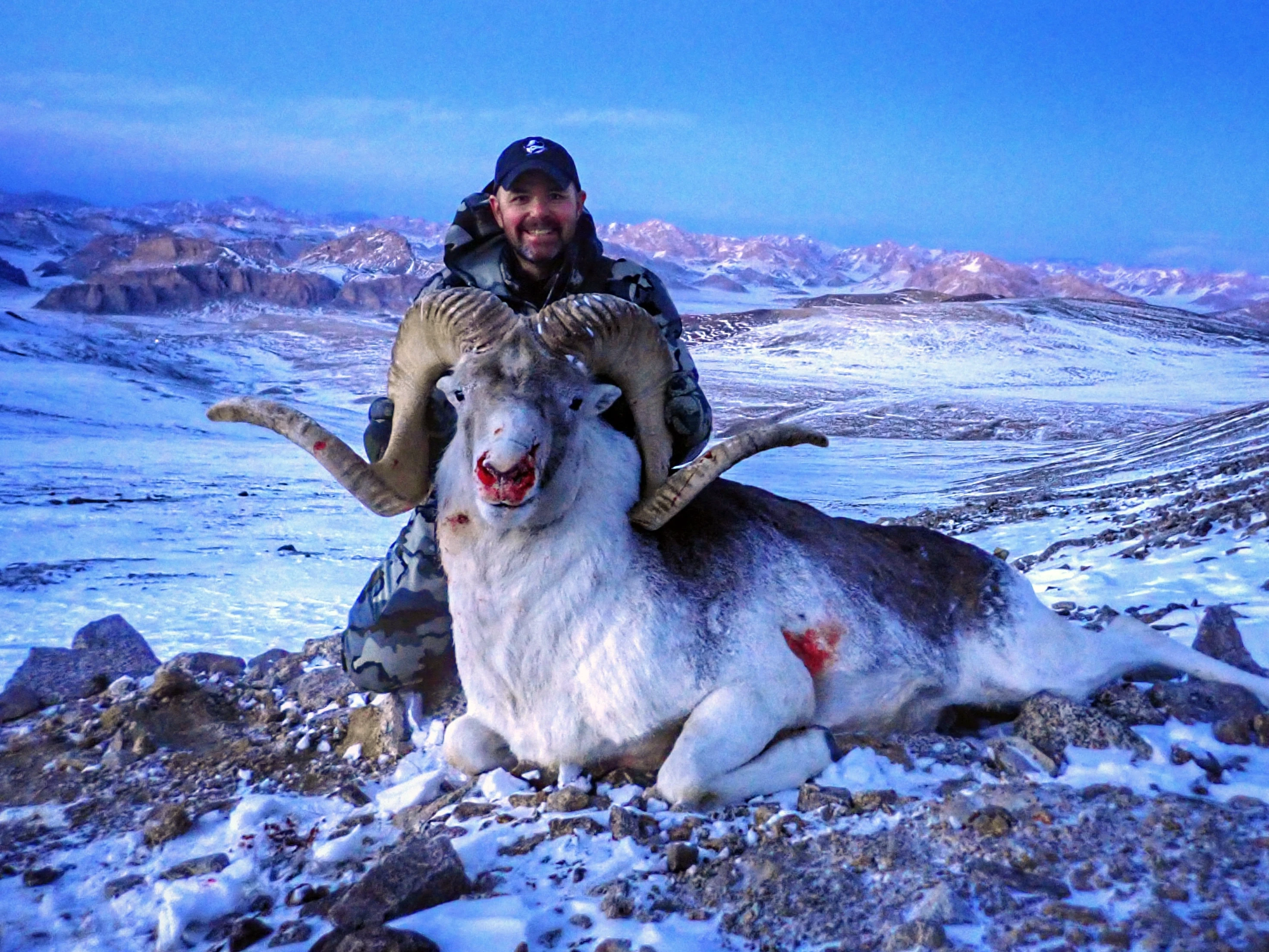
It came down to a choice between the ram I took and stalking another with a 50/50 chance of getting to 800 yards. This one had a lot more mass and I had a better position for a shot. 15,000 feet. 10 degrees. 20 mph headwind. 630 yards. Tight window into quartering away. Single best shot of my life.
Meals in camp were a multi-course affair. Lots of different jams for the lots of different breads. Salad was a platter of pickled then shredded carrots, beets and cauliflower, then soup, main course, dessert. Bottomless green tea and black tea. Every meal had meat from our sheep and ibex.
Hunting feeds my soul, in more ways than one.
One family lives in the most inhospitable place I’ve ever seen. Last winter they hit record temperatures of -70 with nothing more than dried yak dung to burn for warmth, brown bricks stacked on the fence drying for winter. Without hunters coming to this desolate place, the outfitter would not be there to provide supplemental food and toothache medication for the children. Or to protect the Marco Polo sheep from poachers with 40 trail cameras and patrols across tens of thousands of acres that sometimes escalate to exchanging gunfire. Hunters putting their lives on the line to protect and conserve the animals they hunt. Hunting may not be your thing, but you need to recognize its importance.
Along the way